 12 min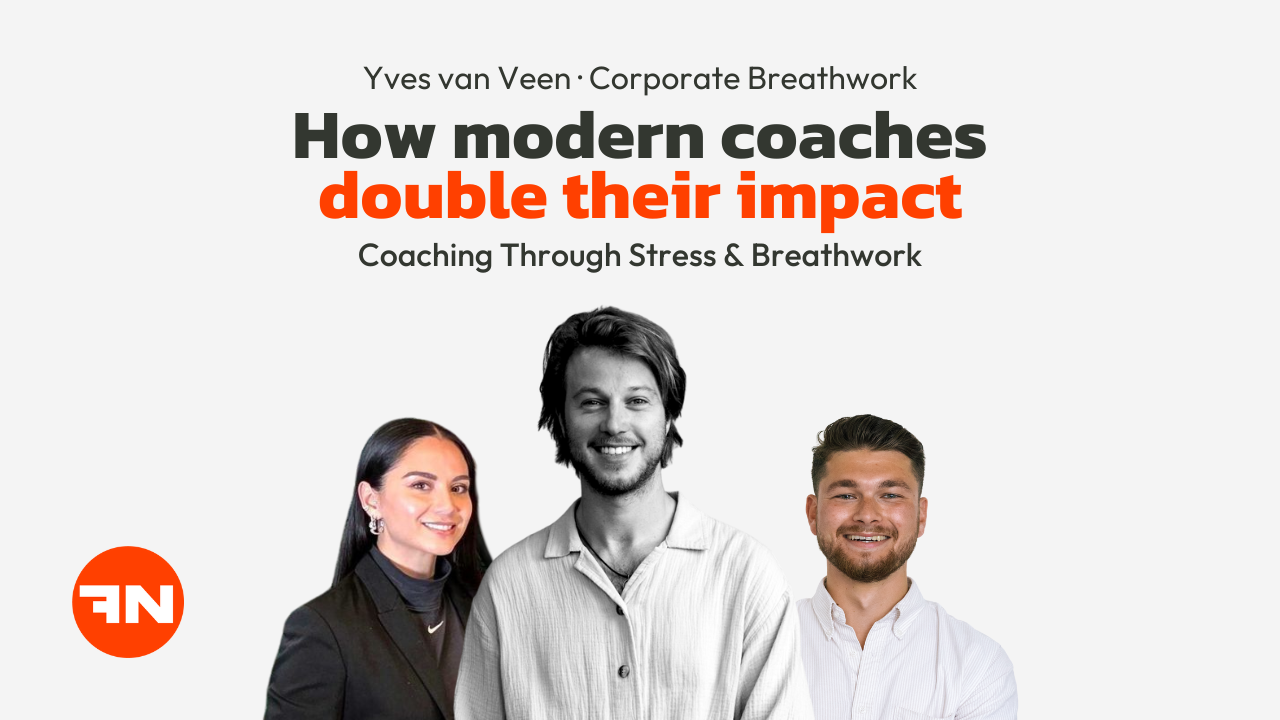
Coaches today face a growing challenge: clients train harder than ever, yet struggle more than ever with stress, recovery, and emotional regulation.
In gyms, studios, and corporate environments alike, performance often collapses not because of poor programming, but because the nervous system is overloaded.
In this FitNation episode, performance coach and breathwork specialist Yves van Veen offers a compelling perspective on why modern coaching must go deeper than sets, reps, and willpower.
Drawing from his work with high-performing teams in business, defense, and elite sport, he shows that real change starts with physiology — the stress patterns, beliefs, and breathing habits that shape how someone shows up in training, work, and daily life.
Yves often works with people who appear successful on the outside, yet still struggle to regulate their inner state.
For coaches, that gap between outer performance and inner wellbeing is not a limitation — it’s the opportunity. Understanding what drives someone beneath the surface is becoming a defining skill for anyone who wants to create meaningful, long-term transformation.
This article explores what modern coaches can learn from stress science and how to integrate breathwork without “being spiritual”, thereby, Yves has distilled the most relevant insights for fitness professionals:
- Why the nervous system should inform every coaching decision.
- How breathwork can be used as a practical, science-backed tool.
- How to read clients beyond the words they say
- How technology can extend your impact far beyond the session.
For coaches building resilient clients - and sustainable businesses - this conversation offers a roadmap to the future of coaching.
1. Start With the Nervous System, Not With the Program
Most coaches begin a session by opening their schedule or reviewing the training plan.
Yves begins by observing someone’s state.
Before a single rep is completed, the nervous system is already telling a story. Subtle signals - shallow breathing, raised shoulders, restless posture, rapid speech - reveal far more about a client’s readiness than any questionnaire or warm-up ever could.
As Yves affirms, if a client walks in disconnected from their body, “you can’t expect them to perform at a high level. Their system simply isn’t ready.”
Coaching, in other words, is not just task execution. It’s state management.
A client stuck in fight-or-flight cannot focus, learn new skills, or regulate their effort, no matter how well-designed the program is. Performance begins with awareness — both for the coach and the client.
That’s why Yves encourages trainers to start every session with two simple but powerful questions:
- In what state does someone enter the session?
- In what state do you want them to leave?
These questions shift coaching from what someone must do to how someone is doing internally. When you anchor training in the nervous system, you’re no longer just guiding movement — you’re guiding regulation, resilience, and self-awareness.
This is where deeper coaching begins.
2. Breathwork as a Practical Coaching Tool Not a Spiritual One
Breathwork often carries a reputation for being abstract or “spiritual,” yet the physiology behind it is anything but it, as it is thoroughly evidence-based.
Modern research shows that breathing is one of the fastest ways to influence the nervous system — and for coaches, that makes it an exceptionally practical tool.
As Yves explains, many stressed clients don’t even realize how their breathing changes under pressure: it becomes faster, shallower, and higher in the chest.
This pattern signals the body to stay in a state of mobilisation, even when the threat is only a tight deadline or a demanding workout. And crucially, the nervous system responds to this pattern just as strongly as it would to real danger.
“The nervous system doesn’t know the difference between actual threat and everyday stress,” Yves says. “But the moment you change your breath, you change your state.”
This is where breathwork becomes deeply accessible to coaches:
- Changing the breath lowers physiological arousal.
- It improves focus, emotional regulation, and recovery.
- It works within seconds — often before a workout even begins.
And none of it requires incense, meditation cushions, or spiritual framing. It can be explained in simple, grounded terms:
- “This slows your heart rate.”
- “This activates your parasympathetic system.”
- “This is the same technique elite athletes use to reset between high-pressure moments.”
When clients feel the shift immediately, the label stops mattering. What matters is that they experience more clarity, more calm, and more control.
Breathwork isn’t mystical — it’s neurological. And for coaches, it’s one of the most accessible tools to change a session from the inside out.
So… what do we mean by “breathwork”?
You’ve probably heard the term popping up more and more in recent years, but many people haven’t really stopped to think about what “breathwork” actually refers to.
At its core, breathwork is the intentional use of controlled breathing techniques to influence the nervous system. By adjusting the depth, pace, and pattern of your breath, you can shift your physiological state — from stressed to calm, from unfocused to centered, from fatigued to recovered.
Breathwork isn’t a spiritual practice by default; it’s a scientifically grounded method used in high-performance sports, clinical psychology, and stress management.
It’s one of the fastest and most accessible tools we have to regulate the body and mind — which is exactly why it’s becoming so relevant for modern coaches.
💡 Want to dive deeper into Yves’ insights?
▶️ Watch the full FitNation podcast episode with Yves van Veen on YouTube
🎧 or listen on the go — and even watch — the episode on Spotify to hear his complete insights on stress, breathwork, and human behavior.
3. Read Clients Beyond Their Words: Resistance, Beliefs & Body Language
Most clients don’t struggle because they lack discipline — they struggle because their underlying beliefs and stress patterns dictate how they behave.
As Yves explains, behavior is almost always the expression of an internal state. If you want to coach people effectively, you must learn to read what they’re not saying out loud.
Many clients carry beliefs such as:
- “Rest equals weakness.”
- “I’m only valuable when I push hard.”
- “If I slow down, I fall behind.”
These convictions shape everything: their training intensity, their self-talk, their willingness to be vulnerable, and even their physical posture.
That’s why Yves pays close attention to body language. It reveals what someone’s nervous system is doing long before they explain it:
- Crossed arms or leaning back → subtle resistance
- Hesitation → uncertainty or a lack of psychological safety
- Over-eagerness → stress disguised as motivation
- Slow recovery → an overactivated system, not a lack of fitness
“When people arrive in a stressed state,” Yves notes, “you can’t simply coach them harder and expect better results. You have to meet them where they are.”
Coaches who develop this skill shift from giving instructions to offering insight.
They help clients understand why they react the way they do, which turns sessions into moments of self-awareness rather than just physical effort. And when clients feel seen — not just corrected — their trust deepens, and their progress accelerates.
This is the difference between running a workout and guiding a transformation.
4. Build Rhythms: Peaks, Recovery & Sustainable Performance
In elite sport, athletes train in deliberate cycles. They build up, peak, recover, and reset — a rhythm designed to protect both performance and longevity.
Yet in the corporate world, and even in many gym clients’ lives, this rhythm is often missing. People often operate in a permanent “peak state,” pushing without pause and mistaking constant output for progress.
Yves sees and knows by experiencing the consequences firsthand.
Many high-performing clients are intelligent, ambitious, and outwardly successful — yet their nervous systems are exhausted.
“In business,” he explains, “the peaks aren’t clearly defined. So people never truly step out of performance mode, and that’s where burnout starts.”
For coaches, this presents an opportunity to add enormous value.
Teaching clients to recognise and respect their physiological cycles can be just as important as teaching them to squat or deadlift. Practical ways to integrate this into coaching include:
- Naming and normalising stress signals
Clients learn to identify when they’re overreaching versus genuinely progressing. - Programming intentional recovery
Not as an afterthought, but as a built-in part of the coaching framework. - Creating weekly and seasonal rhythms
Differentiating between “push phases” and “restore phases.” - Helping clients distinguish productive fatigue from depletion
One drives adaptation — the other drives collapse.
Across both business and sport, one principle remains the same:
No recovery means no progress — only accumulation of stress.
When coaches build rhythmic work–recovery cycles into their programs, they help clients perform at a high level without sacrificing their wellbeing.
It turns training from another stressor into a structured pathway for resilience.
5. Use Technology to Support Coaching Beyond the Session
Many coaches worry that digital tools might make their work feel less personal or even replaceable.
In reality, technology does the opposite: it extends your presence into the moments where clients need support the most.
Yves saw this challenge clearly after years of delivering in-person workshops.
Participants left inspired, grounded, and motivated — yet months later, many admitted they struggled to continue on their own.
Life simply took over. “Even when people had a powerful experience,” he explains, “they often didn’t know how to integrate those tools into daily life.”
His solution became Breathstate , a practical app that allows clients to regulate themselves wherever they are. The same techniques introduced in coaching sessions are now available through short, accessible exercises for focus, recovery, or deep rest.
For coaches, this model demonstrates a broader shift in the industry:
Technology doesn’t replace the coach — it anchors the coaching.
Digital tools enable:
- Consistency between appointments
Clients don’t lose momentum between sessions. - Micro-moments of regulation
Before a meeting, a workout, or a stressful conversation. - A sense of ongoing connection
Video or audio guidance keeps the coach’s presence alive. - Personalisation at scale
Clients receive support that goes far beyond 1:1 time.
As Yves puts it, technology helps clients feel as if their coach is “with them” even when they’re not physically present. And in a world where stress accumulates in the small moments of daily life, that continuous support can be transformative.
Hybrid coaching isn’t the future — it’s the new standard.
Coaches who integrate the right tools amplify their impact and become part of their clients’ routines, not just their weekly schedules.
6. Authenticity Is Your Competitive Edge
When Yves entered the breathwork space, it was already crowded. Dozens of new practitioners were appearing every month, all trained in similar techniques.
But he quickly learned something essential: clients don’t choose methods - they choose people.
“People don’t work with you because you know a technique,they work with you because they trust who you are in that role.” Yves explains.
Authenticity isn’t a branding concept; it’s a business strategy.
For coaches, this matters now more than ever.
As online tools grow and competition increases, your identity becomes your differentiation.
The coaches who stand out are not necessarily the most polished — they’re the most human, the most consistent, and the most willing to show what they believe in.
Lessons modern coaches can take from Yves’ journey:
- Show your face and voice early
Visibility builds familiarity, and familiarity builds trust. - Be consistent, not perfect
Clients don’t expect flawless coaches; they expect real ones. - Don’t imitate success — build your own version of it
Inspiration is useful, but copying dilutes your impact. - Use platforms strategically (email, social, apps)
Staying top-of-mind keeps doors open for future clients. - Surround yourself with people who push you forward
Your environment shapes your growth as much as your skills do.
Yves’ own early years weren’t glamorous. He grew his business during uncertain times, lived simply, and surrounded himself with peers who were also building something from scratch. That environment provided accountability, creativity, and a shared belief that growth takes time.
Authenticity is not a slogan — it’s daily practice. It’s the quiet confidence that your unique perspective, energy, and story are not weaknesses, but the very things that make clients choose you.
7. The Future of Coaching: Push Hard, Recover Hard
The fitness industry is transforming.
Gyms are no longer just places to lift weights — they’re evolving into wellness hubs where members expect guidance on stress, sleep, recovery, and resilience.
People want to perform at a high level, but not at the cost of their health.
Yves explained this shift clearly in the #2 Fitnation podcast episode.
The coaches who will thrive are the ones who understand both sides of performance: the intensity that drives progress and the recovery that makes it sustainable.
“People want to go full throttle,” he says, “but they also want to know how to recharge. Those two things have to go hand in hand.”
This emerging landscape requires coaches to integrate tools and skills that, until recently, lived outside traditional fitness coaching:
- High-intensity training paired with nervous system downregulation
- Breathwork, emotional awareness, and mobility as standard elements of a program
- Cold exposure, heat therapy, and recovery protocols
- Data tracking that reflects not just reps but readiness and stress
- A blend of performance psychology and physiology
Members are more informed than ever — but yet more stressed than ever.
They aren’t just seeking workouts; they’re seeking better energy, clarity, mood, and resilience. And they want coaches who can help them navigate all of it.
The future of coaching is hybrid, holistic, and human-centered. It’s no longer about choosing between intensity and wellbeing. It’s about integrating both with intention.
Coaches who learn to master this balance won’t just improve performance — they’ll redefine what modern coaching can be.
Final Takeaway

Coaching is evolving. Clients no longer come to the gym solely for physical results — they come looking for clarity, resilience, and support that fits into the realities of modern life.
The next generation of high-impact coaches understands that human performance isn’t built on discipline alone, but on the ability to regulate stress, read behavior, and create environments where people can thrive.
Yves van Veen’s approach offers a clear path forward.
By grounding coaching in physiology, integrating breathwork, and paying attention to the inner world that drives outer performance, trainers can unlock progress that goes far beyond a single session.
And when technology extends that support between appointments, the coaching relationship becomes continuous, not episodic.
The message is simple:
Combine science with humanity, and coaching becomes transformation.
For any coach, gym, or studio looking to build more resilient clients — and a more sustainable business — this shift isn’t optional.
It’s the blueprint for the future.
➡️ Ready to explore the full conversation?
Watch the FitNation podcast episode with Yves van Veen on YouTube
or listen — and watch — the episode on Spotify to learn how modern coaches are redefining performance from the inside out.