12 min
Your members are already spending money on supplements—many supplement users spend around $600 per year on products that support their health and fitness goals.
By offering supplements in-house, you can participate in an industry worth more than$30 billion annually in the U.S. alone, create an additional high-margin revenue stream, and strengthen the connection between training and nutrition.
This guide covers everything from supplier selection and pricing to displaying products and selling through your gym’s app.
Why selling supplements is worth it: the financial case
Selling supplements at a gym isn’t about convincing people to buy something they don’t need. It’s about serving a demand that already exists.
Many gym goers purchase protein powders, pre workout formulas, creatine, vitamins, and recovery products as part of their fitness routine. If those products aren’t available in your gym, members will simply buy them elsewhere.
That’s why supplements remain one of the most accessible ancillary revenue streams in the fitness industry.
The numbers add up quickly
The exact results will vary from facility to facility, but industry data suggests that supplement users spend around $50 per month on supplements, while in-gym supplement sales can generate 30–50% gross margins.
Using those benchmarks, here’s a simple example for a gym with 500 active members:
- 20% of members (100 people) purchase supplements regularly
- Average monthly spend per customer: $50
- Average gross margin: 40%
In this scenario, the gym would generate:
- $5,000 in monthly supplement sales
- $2,000 in monthly gross profit
- $24,000 in annual gross profit
This is an illustrative example rather than a forecast, but it demonstrates how supplement sales can become a meaningful secondary revenue stream without adding more members or increasing floor space requirements. For many facilities, that can represent the equivalent profit contribution of dozens of additional memberships.
More than just revenue
Supplements can also support:
- Better member results
- Increased engagement
- More touchpoints with staff
- Higher perceived value
- Stronger member retention
When members see nutrition as part of your coaching ecosystem, they’re more likely to stay connected to your business.
If you’re exploring multiple revenue opportunities, our guide on how to increase gym revenue offers additional strategies beyond retail sales. Likewise, understanding gym member retention strategies helps maximize the long-term value of every customer.
For newer facilities, supplement sales can become an important revenue pillar alongside memberships and personal training, especially when startup costs are still being recovered. See our article on how much does it cost to start a gym for a broader financial perspective.
Should your gym sell supplements?
Selling supplements can create a valuable new revenue stream, but it isn’t the right fit for every facility. Before you get started, ask yourself these questions:
Your readiness checklist
✓ Do members already ask about supplements?
If members regularly ask about protein powders, recovery products, or nutrition support, there’s already demand you can serve.
✓ Can your staff explain products responsibly?
Team members don’t need to be nutritionists, but they should understand the purpose, benefits, and appropriate use of the products they recommend.
✓ Is someone responsible for inventory?
Even a small retail offering requires someone to manage stock levels, orders, and product availability.
✓ Can you start with a low-risk product range?
Begin with a small selection of proven bestsellers rather than trying to stock every product category from day one.
✓ Can members buy both in-club and online?
The easier it is for members to purchase, the more likely they are to do so. Offering both options creates flexibility and convenience.
✓ Can you track sales and inventory performance?
You should be able to see which products sell, which don’t, and what inventory is approaching its expiration date.
When you’re ready
If you answered “yes” to most of these questions, supplement sales could be a natural extension of the services you already provide. The next step is creating a simple, sustainable process that supports both your members and your business.
Step 1 — Know your members: who buys what
One of the biggest mistakes gym owners make is ordering products before understanding demand.
A supplement shelf should reflect member goals, not industry trends.
Match supplements to member objectives
Different groups typically purchase different products.
Muscle-building members
- Whey protein
- Creatine
- Pre workout
- Recovery formulas
Weight-loss focused members
- Meal replacements
- Protein powders
- General wellness products
General fitness members
- Multivitamins
- Protein
- Hydration products
Performance-oriented athletes
- Creatine
- Performance supplements
- Recovery products
The closer your inventory aligns with member goals, the faster products move.
Ask before you order
Before investing in inventory:
- Survey members
- Ask personal trainers what clients already use
- Review common nutrition questions
- Track product requests at reception
A simple survey can prevent thousands of dollars in slow-moving inventory.
You can also test demand before placing large orders. Consider running a pre-order campaign, collecting interest through a member survey, or starting with small wholesale quantities. The goal is to validate demand before committing significant capital to inventory.
If a product doesn’t generate interest before you stock it, it’s unlikely to become a bestseller once it reaches the shelf.
The goal isn’t to stock everything. It’s to stock the right products.
Step 2 — Choose the right supplements to stock
When gym owners first start selling supplements in their facility, they often overcomplicate product selection.
Start small.
Focus on products with broad appeal and proven demand.
Start smaller than you think
Many first-time supplement retailers buy too much inventory too soon. A better approach is to start with 5–10 core SKUs and expand based on actual member demand.
For most gyms, an initial product range might include:
- 2–3 protein products
- 1–2 creatine products
- 1–2 pre-workout products
- 1 multivitamin
- 1 hydration or recovery product
A smaller range reduces inventory risk, simplifies staff training, and makes it easier to identify your best-selling products.
Start with the proven staples
If you’re wondering about the best supplements to sell at a gym, begin with products that have consistent turnover across almost every member demographic.
These include:
- Whey protein
- Creatine monohydrate
- Pre workout
- BCAAs
- Multivitamins
Why these products?
Because most fitness enthusiasts already understand them. There’s less education required and lower purchasing friction.
Whey protein remains one of the strongest performers because it supports muscle recovery and aligns with a wide range of workout routines.
Creatine continues to grow in popularity thanks to strong research support and broad use among both recreational exercisers and athletes.
For first-time retailers, these staples should represent the majority of inventory.
How to evaluate a supplier
This is one of the most important decisions you’ll make.
The cheapest supplier is rarely the best supplier.
Look for products that carry respected third-party certifications such as:
- NSF Certified for Sport
- Informed-Sport
- Informed-Choice
These certifications help demonstrate product quality and testing standards.
Before signing with a company, ask:
What is the minimum order quantity (MOQ)?
Large MOQs can create unnecessary inventory risk.
What are the lead times?
Reliable replenishment matters more than huge opening orders.
What is the return policy?
Especially for damaged or expired products.
What margins can I expect?
Wholesale pricing typically supports margins between 30% and 50% for established brands.
Do products comply with local regulations?
Always verify registrations, ingredient disclosures, and labeling requirements before selling supplements.
A good supplier should feel like a business partner, not just a vendor.
Branded vs. private label
Many gym owners eventually explore private label supplements.
The appeal is obvious.
Margins are often significantly higher than traditional retail products.
Branded supplements | Private Label Supplements | |
Pros |
|
|
Cons |
|
|
For most gyms, private label supplements for gyms become realistic once there is consistent member demand and reliable sales history.
One of the biggest mistakes new supplement retailers make is launching a private label product too early. While margins can be attractive, private label requires larger inventory commitments, stronger demand forecasting, and more operational complexity.
For most gyms, selling established brands first is the fastest and lowest-risk way to validate demand.
Private label should be viewed as a growth strategy, not a starting strategy.

Step 3 — Pricing for profit: margins and strategy
Pricing should balance profitability and member trust.
Trying to beat Amazon on price is usually the wrong strategy.
Amazon wins on scale. Gyms win on trust, convenience, and guidance. Members aren’t paying only for a tub of protein powder—they’re paying for recommendations from people who understand their goals.
Convenience, expertise, and relationship value justify reasonable pricing differences.
Competing solely on price often creates a race to the bottom that reduces margins without creating long-term loyalty.
Typical gym supplement margins
Product Type | Typical Wholesale Cost | Typical Retail Price | Approx. Margin |
|---|---|---|---|
Whey Protein | $30 | $50 | 40% |
Creatine | $15 | $25 | 40% |
Pre Workout | $24 | $40 | 40% |
Multivitamins | $12 | $24 | 50% |
Private Label Products | Varies | Varies | 60–70% |
Average gym supplement profit margin typically falls between 30% and 50% for branded products.
Pricing strategies that work
Rather than relying solely on single-item sales:
Bundle products
=> A product bundle is a group of different goods or services sold together as a single unit, often for a lower price than buying each item on its own.
Example:
- Whey protein
- Shaker bottle
- Training plan
Create PT packages
Combine nutrition support with coaching services.
This approach also complements broader efforts to generate personal training leads .
Offer volume discounts
=> A volume discount is a price reduction given to buyers who purchase large quantities, lowering the per-unit cost to encourage bulk buying.
Examples:
- Buy 2, save 10%
- Monthly protein subscriptions
Run limited promotions
Short-term offers create urgency without permanently reducing margins.
The goal is to increase lifetime customer value, not simply move inventory.
Step 4 — Set up your physical retail space
Even great products won’t sell if nobody notices them.
Retail presentation plays a major role in supplement sales.
Where supplements should be displayed
Many gym owners place supplements near the entrance.
In reality, some of the highest-converting placements are near the exit.
Why? Members are more likely to make a purchase immediately after a workout than before one.
The best locations include:
- Front desk checkout area
- Exit pathways
- Smoothie or nutrition bars
- Consultation spaces
Visibility matters.
Good lighting, clean displays, and organized product categories improve the buying experience.
Organizing supplements by function also helps members navigate options more easily.
For example:
- Recovery
- Muscle gain
- Energy
- General wellness
Minimum viable retail setups
You don’t need a supplement superstore.
Start with what fits your facility.
Option 1: Dedicated shelf
Best for smaller studios and personal training businesses.
Option 2: Full retail display unit
Ideal for facilities with moderate member traffic.
Option 3: Nutrition bar
Encourages product sampling and trial.
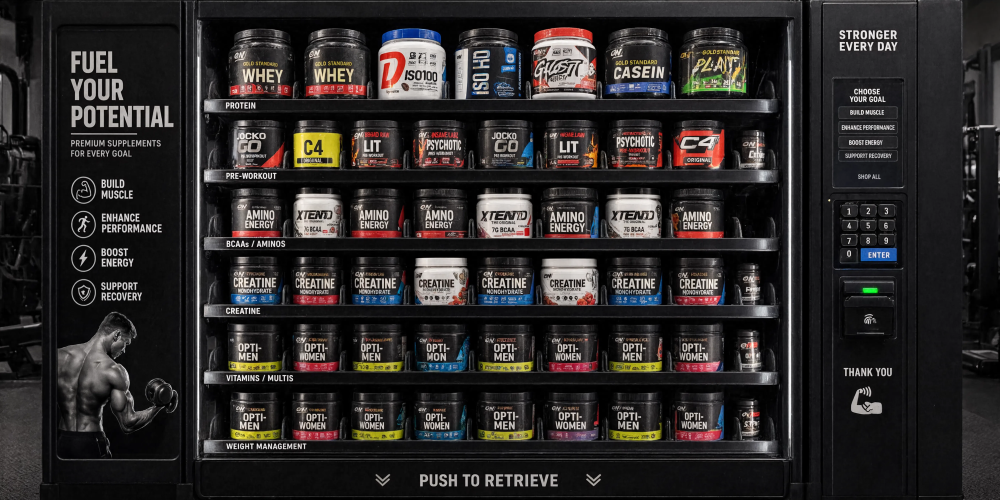
Option 4: Vending machine
Excellent for 24/7 facilities where staff aren’t always available.
The key is creating an attractive, accessible retail experience without overinvesting in inventory.

Step 5 — Educate your members without crossing legal lines
Education drives supplement sales.
Pressure hurts them.
Members trust gym owners and coaches because of their fitness expertise. That trust should be protected.
In fact, staff education is one of the most important factors in a successful supplement program. The fastest way to lose credibility is having team members recommend products they don’t understand.
Members don’t expect medical expertise. They expect honest, knowledgeable guidance. When staff can confidently explain what a product does, who it may be suitable for, and how it fits into a fitness goal, supplement sales become a natural extension of coaching rather than a retail transaction.
What gym owners and PTs can and cannot say about supplements
In most markets, fitness professionals can:
- Explain how products are commonly used
- Discuss ingredient functions
- Recommend products aligned with fitness goals
- Share general educational information
They should not:
- Diagnose medical conditions
- Claim products treat diseases
- Guarantee results
- Provide medical advice outside their qualifications
For example:
Acceptable
“Many members use whey protein to help increase daily protein intake.”
Not acceptable
“This product will cure your muscle loss.”
When in doubt, focus on education and refer members to qualified healthcare professionals for medical concerns.
Build trust through education
The most successful supplement programs prioritize guidance over sales pressure.
Try:
- Product workshops
- Supplement starter guides
- Sampling events
- Goal-based recommendations
- Follow-up feedback surveys
Many consumers actively seek information before purchasing supplements.
Providing that education strengthens trust and improves customer satisfaction.
This works especially well when integrated with nutrition and personal training services.
Remember: relationships drive retention. Sales follow trust.
Sell supplements online through your gym app
Modern consumers expect flexibility.
That means supplement sales shouldn’t be limited to a physical shelf.
An omnichannel approach allows members to purchase whenever it’s convenient.
Benefits include:
- 24/7 availability
- Click-and-collect options
- Automated promotions
- Better inventory visibility
- Higher repeat purchase rates
Using a webshop and point of sale solution allows gyms to manage inventory and transactions without adding a separate ecommerce platform.
You can also promote new products through email marketing campaigns and connect purchases to loyalty initiatives such as challenges and rewards .
The easier it is for members to buy, the more likely they are to purchase consistently.

FAQ
How much profit do gyms make selling supplements?
Most gyms earn margins between 30% and 50% on branded supplements. Private label products can generate margins of 60% to 70%. Actual profits depend on member demand, pricing strategy, and inventory management.
What supplements sell best at gyms?
The best supplements to sell at a gym are typically whey protein, creatine, pre workout products, BCAAs, and multivitamins. These products appeal to a broad range of gym members and generally offer faster inventory turnover.
How do I choose a supplement supplier for my gym?
Look for suppliers that offer third-party certifications such as NSF Certified for Sport, Informed-Sport, or Informed-Choice. Also evaluate minimum order quantities, lead times, return policies, product testing standards, and wholesale pricing.
Can gym staff recommend supplements to members?
Yes, gym staff can provide general education and recommend products aligned with fitness goals. They should avoid making medical claims, diagnosing conditions, or guaranteeing results.
Is it worth creating my own supplement line?
Private label supplements can be highly profitable, but they require upfront investment and consistent demand. For most gyms, it’s best to start with established brands before launching a proprietary product line.
Can I sell supplements through my gym’s app?
Yes. Many gyms use integrated webshop and point-of-sale systems to sell supplements through their app. This allows members to purchase products online, schedule pickups, and buy outside staffed hours.
Conclusion
Selling supplements at your gym doesn’t have to be complicated. Start with proven products, keep inventory lean, and focus on helping members reach their goals.
As your supplement program grows, the right technology can make managing sales much easier. With Virtuagym’s webshop and point of sale solution, you can sell products in-club and online, manage inventory, and create a seamless buying experience for your members.