 16 min
Welcome to the ultimate guide on how to make money in fitness.
This post goes beyond the basics — it’s your roadmap to building a profitable, scalable, and sustainable fitness business.
Whether you’re a personal trainer, gym owner, yoga teacher, or fitness content creator, this guide breaks down 40+ monetization models by investment level, business type, and complexity — with real-world examples from the US, Spain, and beyond.
Our main goal? Help you pick the right model based on your resources, goals, and audience.
Why This Matters

The health and fitness industry is booming and in 2026, the US alone is projected to hit a record $60 billion in fitness-related spending for the first time ever.
That’s massive.
It reflects a clear truth: there’s real demand, and there’s room for new players.
In fact, health, fitness, and exercise are the #1 resolution focus for 2026, with 54% of goal-setters prioritizing them, ahead of financial goals (49%), nutrition (40%), and relationships (37%).
What people are seeking reflects a holistic view of well-being:
- 50% want to build muscle or strength
- 48% focus on improving mobility, flexibility, or posture
- 46% aim to boost mental health through physical activity
Most fitness professionals rely on 1:1 sessions or gym memberships. Few take the time to diversify their revenue, build digital assets, or think in scalable systems.
But that’s exactly where the biggest growth opportunities are.
This guide gives you:
- Step-by-step business models from low to high investment
- Ideas for gyms, studios, online businesses, PTs, coaches, and fitness influencers
- A framework to think bigger than “just training”
Part 1. What You Need to Know Before You Start Making Money in Fitness

Before you start monetizing, get the foundation right.
Without this clarity, every business idea becomes a distraction.
Here’s what every fitness entrepreneur should have in place before launching their first offer — whether you’re starting a gym, fitness app, online personal training business, or wellness brand.
What do you want to offer — or who do you want to serve?
You don’t need a polished brand. But you do need a focus.
Pick a niche where three things overlap:
- You have experience or credentials
- There’s a real, ongoing need
- You actually enjoy serving this group
Examples: postpartum women, men over 40, hybrid athletes, stressed executives, beginners with mobility issues. The tighter the niche, the faster you’ll get traction.
Pro tip: Don’t guess — test. Use pre-sales, free resources, polls, or direct outreach to validate the demand before building.
Do Market Research
Know your competition — and how you’ll stand out.
Look at what other fitness professionals in your niche are doing:
- What do their offers look like?
- Where are they getting clients from?
- What gaps or opportunities do you see?
Check fitness forums, social media platforms, and product reviews. This step saves you months of wasted effort.
Know your time and money limits
Your answers to these two questions will shape the right path for your fitness business:
- How much time can you commit each week?
- How much money are you realistically able to invest up front?
Understanding these limits will help you avoid wasted energy and choose the most realistic route to build your own fitness business.
In the next section, we’ll explore real-world ways to make money in fitness, based on your business type, investment level, and the complexity you’re ready to handle.
Part 2. 40+ Ways to Make Money in Fitness

Not all fitness businesses are built the same. This section breaks down monetization ideas by investment level, so you can match them to your current time, capital, and audience.
How This Section Works
We’ve organized the monetization models by business type, and within each one, by starting complexity:
- 🟢 Low Investment → great for launching fast with services, content, or simple tools
- 🔵 Medium Investment → adds systems, digital products, and online fitness business models
- 🟡 High Complexity → scalable and defensible: apps, licensing, corporate deals, and more
Each model answers this question:
How can I earn money as a fitness professional without burning out or staying stuck in 1:1 forever?
Ready? Let’s start with Yoga, Pilates & Boutique Studios — one of the leanest and most creative segments of the fitness industry.
Yoga, Pilates & Boutique Studios

If you’re running a fitness studio, teaching group sessions, or building a wellness-driven fitness brand, this is your zone.
The health and fitness industry has seen explosive growth in boutique experiences — and this segment offers some of the lowest-cost ways to start your own business online.
You don’t need to be a personal trainer to succeed here. What you do need is a clear fitness niche, a strong offer, and a way to consistently deliver value to your target audience.
🟢 Low Investment Ideas
Start by selling your time, knowledge, and connection. These models require little to no fitness equipment and let you make money online fast.
1. In-person group training sessions
Classic revenue stream. Ideal if you already serve local businesses or have loyal fitness enthusiasts in your area.
2. Online classes (live)
Stream through a fitness app, Zoom, or even a private social media group. Add value with fitness tips, Q&A, and custom workout plans.
3. Monthly packs or online subscriptions
Turn one-off clients into recurring revenue. Great first step to building an online fitness business or coaching business.
🔵 Medium Investment Ideas
Once you’ve validated your concept, move toward scale and specialization. This is where you start combining digital fitness products, in-person value, and automation.
4. Hybrid memberships
Combine your physical location with an online fitness studio. Deliver downloadable workout plans, nutrition guidance, or access exclusive content via a fitness app or white-label solution.
5. Workshops
Niche topics like mobility, stress relief, or nutrition. Perfect for content repurposing (hello, online courses).
6. Wellness retreats
Multi-day experiences that blend exercise routines, mindfulness, and education. Great for elevating your fitness brand and charging premium prices.
🟡 High Complexity Ideas
These require systems, tech, and clear IP. But the payoff is real — and defensible.
7. Teacher training certifications
Convert your method into a replicable framework. You’re not just a fitness instructor — you become a brand educator.
8. Franchise your model
If your own fitness business has strong systems, this is a way to expand without full gym ownership.
Interested in franchises? Don’t miss our guide about Top Fitness Franchise Opportunities for Entrepreneurs in 2026
9. On-demand content platform
Build your own library of workout videos, training programs, and meal plans. Add a fitness tracker integration, and you’re a platform, not just a person.
👉 Next up: Let’s break down how to grow as a personal trainer or coach
Personal Trainers & Coaches

The role of a personal trainer has evolved.
You’re no longer limited to the gym floor.
Whether you’re running sessions in-person, launching a fitness app, or scaling an online coaching business, there are dozens of ways to make money in the fitness industry today.
You can sell your time, sell your system, or build a platform around your fitness expertise. And you don’t need a massive following — just the right offer for the right target audience.
🟢 Low Investment Ideas
These models are perfect for starting with limited funds — especially if you’re already offering personal training sessions or 1:1 services.
10. In-person 1:1 coaching
Still the foundation of many personal training businesses. Sell session packs or monthly plans.
11. Pre-designed training programs
6–12 week workout plans or digital fitness products. Ideal for building passive income.
12. Small group training
Improve your hourly rate with semi-private formats. Add value with shared fitness goals, workout routines, or nutrition plans.
🔵 Medium Investment Ideas
With some capital or time, you can start to automate and scale. Think systems, not hustle.
13. Online personal training
Combine custom workout plans, progress tracking, and direct support. Use a branded fitness app or white-label tool.
14. Monthly online coaching services
Add check-ins, form reviews, and nutrition guidance. More scalable than traditional PT.
15. Corporate wellness programs
Partner with local businesses to deliver workplace fitness, either on-site or via a digital platform.
You can also sell to HR teams. Offer group training, stress management, or performance coaching. The sales cycle is longer — but the margins are higher.
One of our clients, Saludando, a personal training center in Spain, used Virtuagym’s flexible scheduling functionality to expand beyond their physical space.
They now deliver on-site group classes in corporate environments — working with major clients like Mapfre and Allianz.
🟡 High Complexity Ideas
For trainers ready to go from solopreneur to CEO — these are serious fitness business ideas with scale.
16. Build your personal brand
Use social media platforms, a fitness blog, or a fitness YouTube channel to grow visibility and trust.
17. Hire and mentor other coaches
Grow a team under your brand. Use systems to deliver a consistent client experience.
18. License your training method
Package your unique approach into something other coaches or gyms can buy and replicate.
These models turn a fitness journey into a brand, a team, and a business that works even when you’re offline.
The best personal trainer business model
👉 Up next: Let’s look at gyms and fitness clubs — from entry-level memberships to digital transformations.
Gyms & Fitness Clubs

In today’s fitness industry, your real edge comes from hybrid experiences, upsells, and digital products that go beyond the gym walls.
If you want to build a successful fitness business, this section is for you.
🟢 Low Investment Models
If you’re already open or working with a partner facility, these ideas require minimal extra investment — just smarter packaging.
19. Monthly memberships
Still the core of most gyms. But move beyond access: bundle in fitness training, group training sessions, or fitness app features.
20. Upselling coaching services
Offer personal training, online coaching, or nutrition guidance as premium add-ons.
21. Family or corporate bundles
Create offers tailored to local businesses or multi-user households. Ideal for retention.
🔵 Medium Investment Models
Time to digitize, differentiate, and increase client value — without expanding square footage.
22. Hybrid memberships
Give members access to both in-gym and online fitness studio options. Think downloadable workout plans, workout videos, and on-demand exercise routines.
23. Goal-specific programs
Examples: postpartum fitness, senior mobility, fat loss accelerators. Use these to drive upgrades.
24. Challenges and events
Short-term online challenges or in-person transformation events. Perfect for engaging members and promoting your fitness brand on social media.
Our 20 Creative Online Fitness Challenge Ideas article
🟡 High Complexity Models
This is where you transform your gym from a local space to a scalable fitness business with multiple income streams.
25. Open multiple locations
Apply proven models and operational systems to expand without chaos.
26. Franchise your concept
If your brand, community, and operations are tight, scale with other operators.
27. Develop your own platform
A branded fitness app, online courses, or full SaaS platform serving other gyms, coaches, or clients.
With the right systems, your gym can evolve from a facility into a full fitness brand — offering digital coaching, content, and even selling branded merchandise.
👉 Coming up: Let’s talk fitness apps and digital businesses — how to scale fast, serve global audiences, and earn money online.
Fitness Apps & Digital Businesses

If you’re looking to scale, go global, or build something beyond your own schedule, this category delivers.
Digital-first models let you make money online, sell while you sleep, and reach far beyond your local market.
🟢 Low Investment Ideas
You don’t need a developer or an app from day one. You need a smart offer, a strong message, and tools to deliver it.
28. Free content + paid upgrades
Give value upfront via social media, then monetize with digital fitness products, like workout plans, nutrition plans, or private challenges.
29. Downloadable programs
PDF workout routines, training programs, or meal plans delivered via email or app. Ideal for fitness influencers and fitness professionals looking to earn passively.
30. Affiliate marketing
Recommend fitness equipment, tools, or even other fitness apps. Great for those building a fitness blog, YouTube channel, or email list.
🔵 Medium Investment Ideas
These ideas let you deliver more value without needing to build your own tech stack. Focus on content, experience, and community — not infrastructure.
31. Launch premium digital content bundles
Package workout plans, nutrition guidance, and fitness tips into themed product drops: “30 Days to Core Strength,” “Posture Reset,” etc.
32. Run live or pre-recorded programs
Structure 4–12 week online coaching services with video lessons, PDFs, and email support. Great for selling to fitness enthusiasts or niche audiences.
33. Create a digital brand with real-world activation
Blend your online fitness coaching business with live meetups, branded challenges, or collaborations with local businesses and fitness clubs.
These formats let you stay lean, focus on content and audience-building, and use platforms like Virtuagym to deliver the backend ✅
🟡 High Complexity Ideas
This is where it gets serious. These aren’t just business ideas — they’re business online platforms with long-term defensibility.
34. Online marketplace
Connect users with trainers, programs, or nutrition experts. Think big: high-traffic, curated, value-driven.
35. International expansion
Scale your fitness brand to new languages, platforms, and markets. Localize your fitness knowledge and build global relevance.
The magic here is leverage. You build once — then deliver value at scale to thousands. Welcome to the world of digital fitness products.
Now, let’s zoom out. We’ll explore the most creative ways fitness pros are generating income — not just by training, but by repositioning fitness as community, IP, media, or platform.
Fitness as Platform, Community, or Intellectual Property

The smartest fitness entrepreneurs don’t just sell workouts — they productize their thinking, build ecosystems, and monetize around the real pains people experience: inconsistency, burnout, confusion, isolation.
These models are less about “fitness as a session” and more about fitness as a solution — a system, a movement, a method, or a market.
Fitness as Community or Media
Turn your audience into an asset — not just a follower count.
36. Niche communities
Build a tribe: runners over 40, women in menopause, fit founders. Monetize with memberships, group training sessions, or sponsored content.
37. Fitness events
Yoga + brunch, beach workouts + networking, or charity training sessions. High-margin and great for building your fitness brand.
+100 Gym Event Ideas to Boost Your Engagement and Host Successful Gym Events article
38. Content-first fitness brand
Lead with a fitness blog, YouTube channel, or podcast. Monetize with affiliate deals, digital products, or selling branded merchandise.
This is perfect for fitness influencers, fitness enthusiasts, or any personal trainer building a strong online presence.
Fitness as Intellectual Property (IP)
This is where you stop selling sessions and start selling systems.
39. Create a method
Mobility frameworks, strength protocols, recovery systems. These can become training programs, digital products, or certification courses.
40. License your content or formats
Let others deliver your workout routines, coaching structure, or branded fitness challenges.
41. Offer business toolkits
Meal plan templates, progress tracking sheets, onboarding flows — perfect for other fitness professionals or fitness instructors.
These models are built once, and then sold repeatedly — a real asset play for your own fitness business.
Fitness in the B2B World
Biggest upside. Longest runway. Highest margins.
42. Corporate wellness programs
Sell to HR managers, not end users. Recurring revenue, low churn, and strong budgets.
43. Internal training
Create onboarding, sales training, or culture-building sessions for fitness clubs or gym chains.
44. Strategic partnerships
Collaborate with local businesses, health brands, or clinics. You provide access to a wellness-driven target audience they want to reach.
These are great plays for coaches or gyms looking to scale without saturating their own market.
Next: We’ll wrap up with a fresh perspective on decision-making — not just what you can do, but how to choose what makes the most sense for you.
Part 3. How to Think Creatively (and Choose What to Build)

Let’s be honest — the question isn’t just how to make money in fitness. It’s how to do it your way, without burning out, and with a model that fits your reality.
Here’s how the best fitness entrepreneurs think:
Ask yourself:
What’s the real pain around fitness that hurts more than the workout itself?
Because that’s where the value is.
Is it…
- Inconsistency?
- Burnout?
- Isolation?
- Lack of direction?
- Operational chaos?
Your answer defines the kind of solution you should build. Most successful fitness businesses don’t win by being flashier — they win by being clearer, more consistent, or more useful.
So instead of copying what others are doing, reverse-engineer based on what your target audience really struggles with.
Quick Decision Framework
Here’s a cheat sheet to help you make better, faster decisions about what to launch:
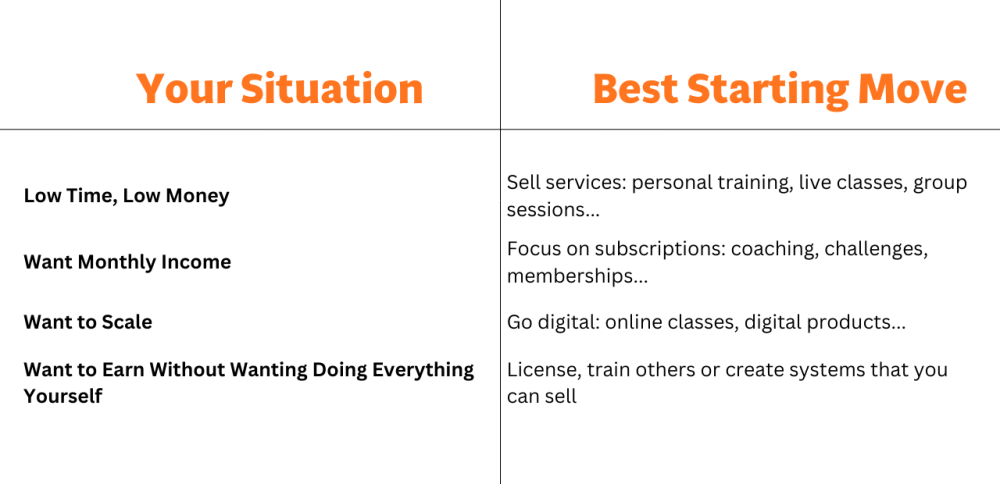
Whatever path you choose — 1:1, hybrid, digital, B2B — make sure it’s designed for your lifestyle, not just your revenue goals.
And remember: the best business isn’t the one with the most features. It’s the one that actually gets used, paid for, and remembered.
Part 4. Is the Fitness Business Actually Profitable?

As Liz Clark, President & CEO of HFA, says:
“The 2025 Fitness Industry Benchmarking Report confirms what we’ve long known: fitness is good business,”
As we’ve seen, the health and fitness industry is booming — with the US expected to hit $60 billion in spending by 2026.
That level of demand creates real opportunity for fitness professionals, especially those who move beyond traditional models and focus on building scalable, sustainable income streams.
But opportunity doesn’t equal profit — unless you structure your own fitness business the right way.
Here’s what the numbers say:
How Much Can You Earn?
If you run your fitness business well, you can keep $20 to $40 of every $100 you make — after covering all your costs. That’s a solid margin in any industry.
What the latest 2025 industry data show is:
- On average, gyms and studios increased their income by nearly 10% compared to 2023.
- Most clubs stayed profitable, with over two-thirds earning more than they spent.
- They also gained more members — around 5.5% growth — and
- Kept about 66% of their members throughout the year.
What Hurts Profitability?
Many fitness businesses fail — especially physical gyms. In fact, 50% of gyms close within five years. The main reasons?
- Too many costs (rent, staff, marketing, tech)
- Weak offers (no clear niche or audience)
- Poor marketing (people don’t even know they exist)
Also: if you’re charging less than you made at your last job, that’s a red flag. This isn’t a side hustle — it’s your own business. You need to price your services to support your life and growth.
How Much Does It Cost to Start?
- Online coaching business: Around $2,000 — for branding, tools, and systems.
- Fitness app: Can vary a lot depending on complexity.
- Opening a gym: Anywhere from $50,000 to $500,000 or more — depending on the size, location, and equipment.
Tips to Make It More Profitable
- Niche down: Specialize in something specific (e.g., postnatal fitness, athletic teens, men over 40).
- Keep clients longer: It’s cheaper to retain than constantly find new ones.
- Add more value: Include nutrition plans, online coaching, fitness tips, or downloadable workout programs to increase what each client spends.
The key? Start simple, stay focused, and grow smart. You don’t need to be the biggest — just the clearest, most consistent option for your audience.