16 min

You already know you can hold a room. Maybe you teach a dozen classes a week at other studios, or you’ve just finished your 200-hour training and keep sketching your own space.
Before you look at leases, you need two numbers: how many members it takes to pay the rent, a support teacher and yourself.
And whether your room and class schedule can hold them at the hours people actually come.
- Members needed = (monthly costs, your pay included, + target profit) ÷ average monthly revenue per member.
- A one-room studio with 18 mats and $7,760 in monthly costs needs 76 members to break even and 90 to earn $1,500 more.
- That room fits about 185 members, and its peak classes fill at around 178.
- Renting a room by the hour for 8 classes a week, with your pay halved to $1,500 to match, cuts the target to 43 members. Each class then needs 9 students instead of 6.
- Mature franchise studios bill the equivalent of 200 to 300 members. A one-room independent can break even on about a third of that.
The two calculations every studio owner should do

You might rent a room by the hour, lease one room or open with two rooms and a team. The questions stay the same.
1. How many members you need. Add up your monthly costs, your own pay and the profit you want. Divide by what an average member pays you each month.
2. How many members fit. Multiply the mats in your room by the classes you teach each week. Keep the share you’ll realistically fill, then divide by how often each member comes.
If you need fewer members than fit, your job is finding them and pricing well. If you need more, extra marketing won’t close the gap: change your price, your class schedule or your revenue mix.
Yoga shifts three inputs compared with a gym or a reformer studio: space per mat, a lower price per visit and the weight of class packs.
We follow one example studio throughout, built on public benchmarks so you can swap in your own figures. If you’re still mapping out the whole launch, start with how to open a yoga studio .
Calculation 1: break-even
Break-even is the number of members at which money in equals money out. Two omissions push it artificially low: leaving out your own pay and forgetting the build-out you paid for upfront.
Fixed costs
The example is an 850 sq ft unit in a neighborhood shopping center: a 20 x 25 ft practice room plus a lobby, changing area and storage.
It runs 22 classes a week. You teach 16 and a support teacher takes 6.
| Monthly cost | Amount | Where it comes from |
|---|---|---|
| Rent | $2,195 | 850 sq ft × $25.82 a year ÷ 12, plus 20% for NNN charges |
| Utilities, cleaning and internet | $450 | Our estimate for a space this size |
| Support teacher (6 classes a week) | $865 | 6 classes × 4.33 weeks × $33.30 |
| Your pay | $3,000 | You decide (see below) |
| Build-out ($30,000 over 5 years) | $500 | $30,000 ÷ 60 months |
| Local marketing | $300 | Our estimate |
| Insurance | $100 | Our estimate for liability and property coverage |
| Software, accounting and card fees | $350 | Our estimate |
| Total | $7,760 |
The rent line uses the national shopping-center asking rent of $25.82 per sq ft a year in Q3 2026, from Cushman & Wakefield .
Most retail leases are NNN, so you also pay a share of property taxes, building insurance and common-area costs. The 20% covers that.
A month averages 4.33 weeks, which is why every weekly figure is multiplied by it.
The $33.30 per class is the BLS median wage for fitness trainers and instructors , $22.20 an hour, times 1.5 hours for the class, setup and check-in.
The build-out is the cost first-time owners forget most. A yoga studio buys no machines, but it pays for flooring, lighting, heating, cooling and changing rooms.
Our yoga studio business plan guide puts total startup costs at $20,000 to $100,000+. How much it costs to open a yoga studio breaks that down line by line.
Your pay line. Teaching your 16 classes freelance at $33.30 each would earn you about $2,307 a month, with no lease and no risk. Your studio pay should never sit below that, so we use $3,000.
Your cost list changes with how you start:
- If you teach every class yourself: there’s no teacher line, but your own pay still belongs in the sum.
- If you rent a room by the hour: no build-out, rent or utilities. You pay per class taught.
- If you build a team: teacher pay usually becomes the biggest line, ahead of rent.
Average revenue per member (memberships vs class packs)
Average revenue per member is what each member pays you a month, averaged across all your members.
The example studio charges $120 a month for unlimited classes. That sits at the floor of the $120 to $250 range for unlimited boutique memberships in the US, according to ThePricer .
It also sells a 10-class pack for $180, or $18 a class. Pack members tend to come less often, so we assume once a week.
| Unlimited (2 classes a week) | 10-class pack (1 class a week) | |
|---|---|---|
| Price | $120 a month | $180 per pack |
| What it brings in each month | $120.00 | $77.94 |
| Members to cover $7,760 | 65 | 100 |
The pack member pays more per class but comes less, so each one brings in about a third less per month. You need 35 more pack members than unlimited members to cover the same bills.
Most studios sell both. If 6 in 10 members are on unlimited and 4 in 10 on packs:
- Average revenue per member: $103.18 a month
- To break even: $7,760 ÷ $103.18 = 76 members
- To earn $1,500 more: $9,260 ÷ $103.18 = 90 members
Always round up. And keep an eye on your pack share: if it moves from 4 to 5 in 10 members, break-even rises to 79.
Calculation 2: class capacity
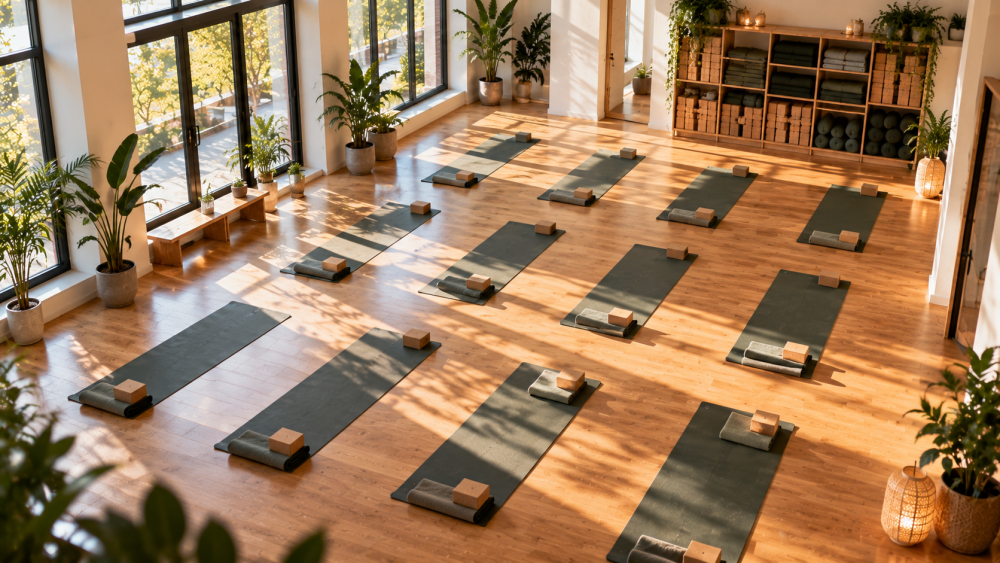
You need 90 members to pay yourself and keep $1,500 profit. Now check whether your room and class schedule can serve them.
Students per class by room size
A standard mat is about 2 x 6 ft. Add arm space and walkways and you need around 27 sq ft per student:
- 20 x 25 ft room (500 sq ft): 18 mats
- 25 x 30 ft room (750 sq ft): 27 mats, or about 30 packed tight
- 30 x 40 ft room (1,200 sq ft): 44 mats
Count only the practice room. Hot yoga needs more space per mat, and the occupancy limit set by your local authority comes before any mat count.
In the example, 18 mats × 22 classes = 396 spots a week. No studio fills them all, so plan on 75%: 297 spots.
Unlimited members come twice a week and pack members once, so the average is 1.6 visits. That means 185 members fit (297 ÷ 1.6), against the 90 you need.
If everyone bought unlimited, 148 would fit and you’d need 65. With packs only, 297 would fit and you’d need 100. You have room to spare in every case.
Occupancy by time slot

The weekly average hides where the real limit sits. Each class costs about $81 to open: $7,760 spread over the 95 classes you teach a month.
Each visit brings in $14.89 on average. So a class pays its share at 6 of 18 mats. A support teacher’s class covers that teacher’s pay with 3 students.
In the example, 10 of the 22 classes run in commuter slots: 6:30 a.m. and 6 p.m. on weekdays. We assume they take 6 in 10 visits.
At 90 members, those peak classes average 9 students. They fill (17 of 18 mats) at around 178 members.
Treat that 6-in-10 split as a cautious assumption: it makes peak classes fill sooner. Real demand is often more spread out.
Placer.ai foot-traffic data shows class-based Club Pilates took only 16.5% of its 2025 visits between 5 and 8 p.m.
If your studio looks more like that, peak classes fill well after 178 members. The quiet classes become the bigger problem, so check your own bookings before you plan around either number.
The off-peak classes have the opposite problem. At 90 members, the 12 quiet classes average about 5 students and bring in around $71 each, below the $81 they cost.
Established studios price around this. UK chain Hotpod Yoga sells an off-peak membership in Sheffield at £60 a month, valid weekdays 7 a.m. to 4 p.m. and weekends after 11 a.m.
In Nottingham, the same chain uses a three-class off-peak taster for £20 to bring newcomers into its quieter slots.
What you can do with each slot:
- Quiet mornings and lunchtimes: a cheaper daytime membership for people with flexible hours.
- Who teaches what: take the quiet classes yourself and give your support teacher the full ones.
- Peak waitlists: raise the peak price before you add more classes.
To make these calls, you need to see how full each class is week by week.
With Group Class Booking , members reserve their mat online and you see which slots fill without counting heads or updating a spreadsheet every Sunday.
Peak and quiet months
The calendar moves your numbers too. Placer.ai found fitness visits in January 2025 were 21.2% higher than in December 2024.
For a new studio, that makes opening date a decision. Opening in the fall gives you a few months to fix your class schedule before the January wave arrives.
Quiet months need a plan as well. Summer vacations and membership holds cut income while rent stays the same.
Run a simple stress test. If 1 in 10 members pauses for July and August, the example studio at 90 members drops to 81 paying members. That’s still above the 76 break-even.
At 80 members, the same pause leaves 72 paying and the studio loses about $330 a month. Know which side of that line you’re on before summer.
Worked example: one-room vs two-room studio
Same prices, same member mix. What changes is how you start: renting by the hour, leasing one room or opening with two rooms and a team.
If you start by renting a room by the hour
Yoga studios on Peerspace rent for $50 to $120 an hour on average. At $75 and 8 classes a week, your monthly costs are:
- Room: 8 classes × 4.33 weeks × $75 = $2,598
- Teacher liability insurance: $13 (policies from $159 a year )
- Card fees and software: $100 (our estimate)
- Local marketing: $150 (our estimate)
- Your pay: $1,500
You teach 8 classes here instead of 16, so we halve your pay to match. It’s still above the $1,153 those 8 classes would earn you freelance.
Total: $4,361 a month. You need 43 members, and each class needs about 9 students to pay its way, against 6 in your own studio.
Before you book, check that the room takes at least 12 mats. That leaves space for 9 students at the 75% occupancy we use throughout.
When to sign a lease. Leaving out your pay and teacher pay, the one-room studio costs $3,895 a month for 22 classes.
Rented rooms at $75 an hour cost the same once you teach about 12 classes a week.
Past that point, and with classes filling, a lease costs you less per class than renting.
If you open a one-room studio
This is the studio we’ve followed so far: 76 members to break even, 90 to earn $1,500 more, space for 185 and peak classes full at around 178.
Few studios open with 76 members. Say 20 students who already follow you sign up on day one, and you add 6 net members a month (new sign-ups minus cancellations).
- From month 5 (44 members), income covers the monthly running costs. That’s everything except your pay and the build-out, which you’ve already paid upfront.
- From month 10 (74 members), it also pays your $3,000 in full.
- From month 11 (80 members), it covers the build-out’s $500 monthly share too, so the studio is at full break-even.
Before month 10, the cash shortfall including your pay adds up to about $24,500. Around $5,100 of it is running costs in the first four months. The rest is your own salary.
Budget that $24,500 on top of the build-out itself, not inside it.
If you open with two rooms and a team
Now a 1,500 sq ft unit with an 18-mat room (500 sq ft) and a 14-mat room (400 sq ft).
It runs 50 classes a week: 28 in the big room and 22 in the small one. You teach 14 and your team teaches 36.
Each room has 10 peak classes, so 20 of the 50 run at peak times.
- Rent: 1,500 sq ft × $25.82 ÷ 12, plus 20% NNN = $3,873
- Utilities, cleaning and internet: $800 (our estimate)
- Teachers: 36 classes × 4.33 weeks × $33.30 = $5,191
- Your pay: $3,000
- Build-out ($50,000 over 5 years): $833
- Marketing: $600
- Insurance: $150
- Software, accounting and card fees: $500
Total: $14,947 a month. It needs 145 members to break even and 174 to earn $3,000 more.
| One room | Two rooms | |
|---|---|---|
| Monthly costs | $7,760 | $14,947 |
| Classes a week | 22 | 50 |
| Members to break even | 76 | 145 |
| Members for profit target | 90 ($1,500) | 174 ($3,000) |
| Members that fit at 75% | 185 | 380 |
| Peak classes full at | 178 | 316 |
| A class pays its share at | 6 students | 5 students |
Both studios have space to spare. The gap is in how many members you need before you stop losing money.
At 120 members, the one-room studio clears $4,621 a month after paying you. The two-room studio loses $2,566. Teacher pay is 35% of its costs, and it starts on day one.
Open the second room when the first room’s peak classes are full, at around 178 members. By then the one-room studio earns about $10,600 a month on top of your pay.
In our experience, studios with several teachers usually have one star teacher who brings in most new members and fills more classes. Don’t plan as if your whole team fills equally.
If that teacher leaves, some members may follow. Help your members get to know more than one teacher from the start.
What established studios run on
IBISWorld counts 37,377 Pilates and yoga studios in the US in 2026, with 2.7 employees each on average . Most are small teams.
Franchise data shows what mature studios bill. Franzy’s analysis of 2024 franchise disclosure documents puts the average yoga and stretch franchise studio at $293,372 a year, and YogaSix at $425,787.
At $120 a month, that’s the revenue of about 204 and 296 unlimited members. Chains charge more than $120, so their real member counts are lower, but the scale holds.
They also pay royalties (7% at YogaSix) and carry bigger build-outs. The example one-room studio breaks even on about a third of an average franchise studio’s revenue.
Revenue that lowers the members you need: workshops, retreats, teacher training

Every dollar you earn outside memberships lowers the number of members you need. To see by how many, divide the net income by $103.18, what one member brings in each month.
Workshops. A 2-hour workshop at $45 (2.5 times your $18 pack class) with 12 students brings in $540. After about 3% in card fees, $524 stays with you.
Teach it yourself on a quiet Saturday afternoon and it costs almost nothing extra: it brings in what 5 members pay in a month. With a guest teacher on a 50/50 split, it’s about 2.5.
That’s one month only. Run a workshop like this every month and you need 5 fewer members all year.
Retreats and teacher training. Money arrives in one go, and so do the costs: venue, food, travel and teachers. To compare them with memberships, spread the net result over 12 months.
Each $1,238 you keep in a year equals one member for a full year ($103.18 × 12). That’s the first bar a retreat has to clear.
The second shows up later. In our experience, a few days away with the group and their teacher changes how students relate to your studio, and they stay members longer.
If 5 retreat guests stay 3 months longer, that’s $1,548, more than the $1,238 bar the retreat itself had to clear.
Keeping that group connected between events is what turns a good weekend into longer memberships. Our guide on why an online community matters for your yoga studio shows how to do it.
Teacher training follows the same math. With 10 trainees, it has to leave $1,238 net per trainee to equal 10 members for a year.
For most new studios, it’s a step for later, once you have a track record and teachers who can lead the program with you.
Conclusion
The two calculations give you a range. In the example, a one-room studio needs 76 to 90 members and has space for about 185, with peak classes full near 178.
For a first studio, space is rarely the limit. Finding members, filling the quiet slots and getting through the first ten months set the real pace.
Renting by the hour is a low-risk way to test demand. Once you teach about 12 classes a week to filling rooms, a lease starts to cost less per class.
Before you sign anything, run both calculations with your own rent, prices and teaching hours. If you’d rather start with one-to-one clients, how many clients a personal trainer needs runs the same math.
Plan your class schedule and see which classes fill from your very first week.
FAQ
How many members does a yoga studio need to break even?
Divide your monthly fixed costs, your own pay included, by the average monthly revenue per member.
A one-room studio with $7,760 in monthly costs and $103.18 average revenue needs 76 members to break even and 90 to earn $1,500 more each month.
How many students fit in a yoga class?
Allow about 27 sq ft per student for the mat, arm space and walkways.
A 20 x 25 ft room holds 18 mats and a 25 x 30 ft room about 27, or 30 packed tight. Hot yoga needs more space, and your local occupancy limit comes first.
Are yoga studios profitable?
They can be, once members cover costs and your pay.
In our example, a one-room studio earns $1,500 a month on top of a $3,000 owner salary at 90 members.
Extra revenue helps: a 2-hour workshop with 12 students brings in what 5 members pay in a month.
Memberships or class packs: which is better?
Memberships bring in more per member each month: $120 versus $77.94 for a pack member who comes once a week.
With packs only, you’d need 100 members instead of 65 to cover $7,760, although each pack member takes fewer spots in class.
How long until a yoga studio is profitable?
Divide the members you still need by your net new members per month.
Opening with 20 and adding 6 a month, the example studio covers its running costs from month 5 and reaches full break-even, owner pay included, from month 11. Budget for that gap before you open.