12 min
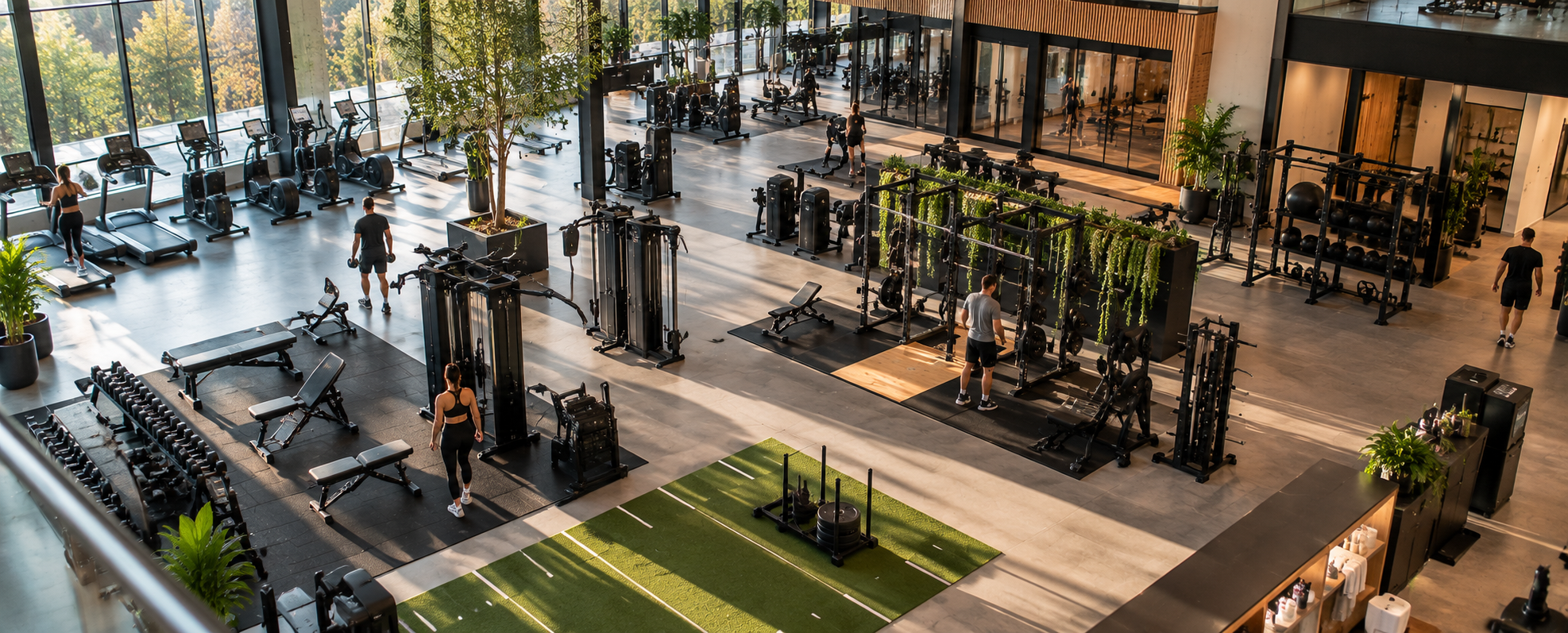
Most new gyms are planned from a catalog. The treadmills look compact on the spec sheet, the delivery date is booked, and only on install day does the floor plan stop adding up.
One commercial treadmill, with the safety clearance around it, claims close to 96 sq ft (9 m²). A row of eight hands 12% of a 4,840 sq ft gym to a single machine type. Choosing basic gym equipment works better in the opposite order, and it’s the first big call when you open a gym .
In short:
- Measure usable floor first and count clearance as part of every machine. From our experience, small gyms run 4,300 to 5,900 sq ft.
- Pick your offer next. Strength, functional, group-led or active aging decides which zone gets the most floor.
- Buy adjustable steel first, then open floor, then cardio.
- Budget $10,000 to $40,000 for small-gym equipment. A full 4,300 sq ft floor lands near the top.
- Size the seniors’ zone from check-in data, using the WHO’s three days a week as a ceiling.
Pro tip: compare quotes from several wholesale fitness equipment suppliers before you commit to one brand.
How to plan equipment for a mixed-age membership
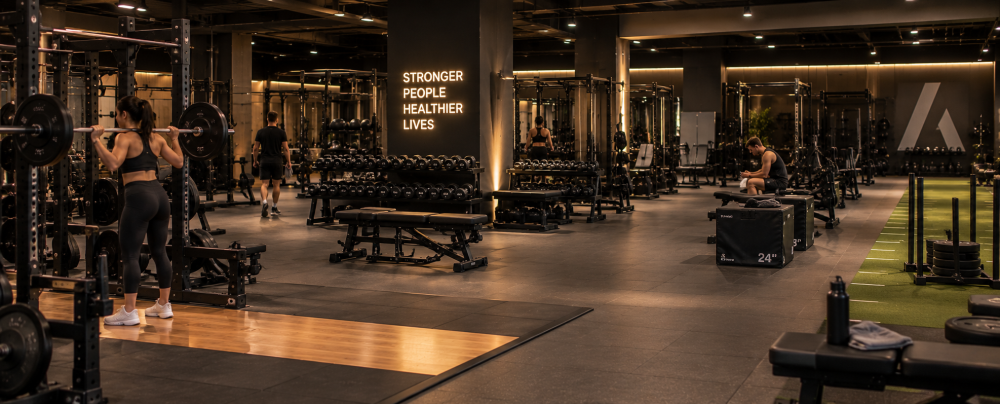
Most equipment mistakes happen before the first order, when a catalog decides the floor instead of the floor deciding the catalog. Work in three steps: space, then offer, then equipment.
Start with your floor space
Usable floor is your total area minus reception, locker rooms, storage and walkways. Every piece of equipment then costs its own footprint plus its safety clearance, and the clearance is often the bigger number.
Free weights behave differently. A dumbbell rack sits against a wall, and the training space in front of it is shared by whoever is using it. One open zone can host bench presses at 10 a.m. and a kettlebell class at 6 p.m.
Takeaway: price each machine in square feet before you price it in dollars.
Define your offer
Your offer sets which zone gets the most floor. Four concepts cover most independent gyms and studios:
- Strength-led: racks, platforms and a long dumbbell run.
- Functional and hybrid: open floor, sleds, kettlebells and ergometers.
- Group-led: a studio space with portable gear that clears in minutes.
- Active aging: supported strength stations, seated cardio and balance tools.
Trend data points the same way, with one caveat. The ACSM 2027 Worldwide Fitness Trends list is led by technology: wearables at #1 and mobile exercise apps at #2.
The training formats come next. Professionals rank balance, flow and core strength #3, programs for older adults #4 and traditional strength training #5. Exercise for weight management sits at #6, and group fitness classes jumped from #13 to #7.
Those formats run on free weights and open floor far more than on single-purpose machines. Keep in mind that the ranks reflect what professionals observe across the industry, not usage measured inside gyms.
Hybrid racing adds to the pull. Hyrox reports more than 1.5 million athletes in its 2025/26 season and expects over 2 million in 2026/27, according to Athletech News .
The offer can also change from one site to the next. Absolutely Fitness , a charity-owned group of four UK clubs, deliberately builds each club around its local community. Some sites run different class timetables, and others have fully equipped ladies-only areas.
Choose equipment that fits both
Run every piece on your shortlist through two filters:
- Does it fit your usable floor once clearance is included?
- Does it serve the offer you defined?
Use a third test only to break ties. If most of your member levels can use a piece from day one, it earns its place sooner.
Decision rule: if classes or hybrid training are part of your offer, open floor beats a line of single-purpose machines. One zone covers group sessions at peak hours and open training the rest of the day.
Basic gym equipment list
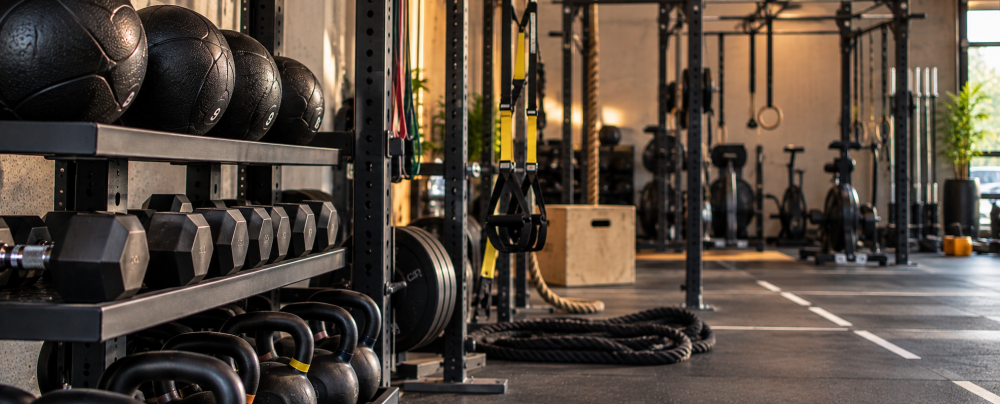
These ten categories cover every member level on one floor. The table compares them on the two filters from the planning step.
| Equipment | Who uses it at entry level | Best fit for | Floor demand |
|---|---|---|---|
| Adjustable bench | All levels | Every offer | Low, shares free-weight floor |
| Dumbbells and rack | All levels | Every offer | Low, rack against a wall |
| Rack, barbells, plates | Beginners and athletes; seniors with coaching | Strength, hybrid | Medium |
| Cable machine | All levels | General, active aging | Medium |
| Functional and hybrid gear | Beginners, athletes | Functional, group, hybrid | Shares open floor |
| Treadmill | All levels | General | High |
| Upright and recumbent bikes | All levels | General, active aging | Medium |
| Rowing machine | Beginners, athletes | Hybrid, general | Medium |
| Elliptical | Beginners, seniors | General, active aging | Medium |
| Balance and mobility tools | All levels | Group, active aging | Minimal, stores small |
Adjustable bench
A bench that moves from flat to incline turns a dumbbell run into a full upper-body station. Seniors get a supported seat for presses and rows, newcomers get stability, and experienced lifters get incline work. Check how easily the backrest adjusts before you buy.
Dumbbell set and rack
Choose a range that starts light enough for a first-week member and goes heavy enough for your strongest regulars. A wall rack keeps the floor clear. Fixed dumbbells handle busy hours better than adjustable ones, because nobody waits for a pin change.
Squat rack, barbells and plates
Under IWF technical rules , the men’s Olympic bar weighs 20 kg (44 lb) and the women’s bar 15 kg (33 lb). The lighter bar is a gentler starting point for anyone building strength from scratch.
Bumper plates let members load in small steps. They can browse barbell exercises in our free exercise library.
Cable machine
If a small gym buys one machine, make it this one. Adjustable pulleys and low starting loads let a senior do a supported row while an athlete trains rotational power on the next handle. One frame covers dozens of exercises.
Functional and hybrid gear
Kettlebells, sandbags, wall balls, a sled and a strip of turf serve functional classes, small-group training and hybrid race preparation. Hybrid race formats combine running with stations such as sled pushes, rowing and wall balls. All of it lives on open floor that classes reuse.
Treadmill
Look for a low starting speed, long handrails and a low step-up height, which help newcomers and seniors get on and off safely. Treadmills are the most space-hungry item on this list, so set the count by your offer before anything else.
Upright and recumbent bikes
Both give low-impact cardio. The recumbent’s back support makes it the first choice for seniors and anyone returning from injury. Typical manufacturer guidance asks for less clearance than a treadmill: 20 in (0.5 m) on at least one side and 20 in behind or in front.
Rowing machine
Rowers train legs, core and upper body in one low-impact movement, and they double as a station in hybrid training. Beginners need a short technique briefing, so add a demo video to their first plan.
Elliptical
Ellipticals protect knees, hips and ankles, which suits beginners and seniors. They are single-purpose and take a fair amount of floor. A functional or hybrid offer needs fewer of them than a general gym does.
Balance and mobility tools
Resistance bands, balance pads, step platforms and half-dome balance trainers cost little and fit on a shelf. They anchor balance and core work, now one of ACSM’s top three trends, and cover the balance training the WHO recommends after 65.
Equipment for older members
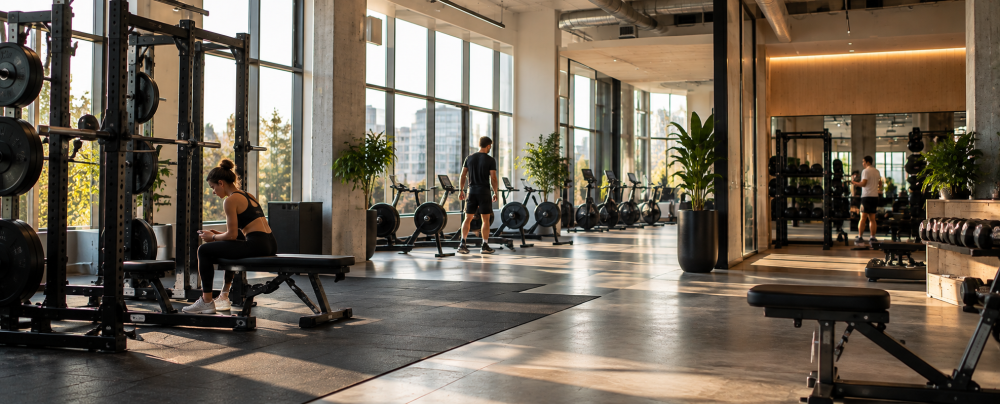
Older members are the easiest segment to underserve and one of the easiest to plan for, because your own check-in data already tells you most of what you need.
How much capacity your seniors’ zone needs
The WHO 2020 guidelines ask adults over 65 to do varied multicomponent activity, emphasizing balance and strength, on at least three days a week. Those three days cover all of a person’s activity, including walks, home workouts and classes elsewhere.
So treat the WHO figure as a ceiling. One hundred members over 65 × 3 days = 300 sessions a week, and only if every one of them did all their training with you.
Plan from your real visit rate instead:
Formula: members over 65 × their average weekly visits (from your check-in data) = weekly sessions to plan for.
If those 100 members average two visits a week, you’re planning for 200 sessions, a third below the ceiling. The gap between the two numbers is also a growth target: every extra visit you win needs room on your floor.
Gym equipment for seniors that works without a spotter
Those sessions need stations that are safe without a spotter or heavy loading:
- A cable machine with low starting loads.
- Benches with supportive backrests.
- Recumbent bikes for warm-ups.
- Balance tools within reach of a wall or rail.
Seniors can share the main strength floor at lower starting loads, with supported and seated options alongside. Programs for older adults rank #4 in ACSM’s 2027 list, which makes an active-aging offer a growth segment worth its floor.
For ideas on bringing these members back, read how to get your older clients back into the gym .
Budget and space planning (buy vs lease)
Small gym equipment costs
Our gym startup cost breakdown puts equipment at $10,000 to $40,000 for a small gym, $30,000 to $100,000 for a mid-size gym and $100,000 to $500,000 or more for a large commercial gym.
Those tiers group gyms by type, not by square footage. The low end suits a compact studio. Fully equipping 4,300 to 5,900 sq ft pushes you toward the top of the small tier, or into mid-size budgets if cardio takes a large share.
Plan maintenance from day one: $500 to $2,000 a month.
How much floor each zone needs
Take a 4,840 sq ft (450 m²) general-fitness gym. Eight commercial treadmills in one row need about 595 sq ft (55 m²) once clearance is counted. That’s 12% of the whole building for one type of machine.
Here is the math:
- Width: 8 machines × 3 ft + 9 gaps × 20 in ≈ 39 ft.
- Depth: 20 in in front + 7 ft of machine + 6.5 ft behind ≈ 15.25 ft.
- Area: 39 ft × 15.25 ft ≈ 595 sq ft.
If your offer leans toward functional or group training, cut the row to four treadmills. That frees about 285 sq ft (26 m²) of open floor for classes at peak times and free training the rest of the day.
Buy or lease
The split that holds up best: buy equipment that lasts, and lease equipment that dates. Our guide on buying or leasing fitness equipment covers the full trade-off.
| Category | Buy or lease | Why |
|---|---|---|
| Racks, benches, dumbbells, plates | Buy | Steel lasts for years and holds resale value |
| Functional gear | Buy | Low cost per item, little wear |
| Treadmills, ellipticals, connected bikes | Lease | Consoles and electronics date quickly |
| Cable machine | Either | Depends on your cash flow at opening |
Connect equipment to your member app
Wearables and mobile exercise apps hold the top two spots in ACSM’s 2027 trends, so members increasingly expect their training to live on their phone. Equipment pays back when they use it with a plan.
Build one program per entry level once in the Workout Plan Creator , then reassign it to every new member who fits. Progress tracking shows who is moving up and who has stalled, so coaches know where to step in.
Some machines feed that data back automatically. You can connect equipment to your member app : Matrix and Life Fitness sync training data through QR codes or RFID tags, and InBody body composition scans land in the member’s profile.
Absolutely Fitness found the app helps members who feel intimidated on the gym floor. Exercise demos show them how to use each station, so they build confidence on their own. For a wider view of the market, see our roundup of the best gym apps for owners .
Conclusion
Equip your gym in the order your building and your offer dictate. Measure usable floor, count clearance as part of every machine, and decide which offer the space serves. Then buy adjustable steel first, open floor second and cardio to fit what’s left.
That order gives a first-timer, a competitive athlete and a 70-year-old something to train with on the same floor. When the equipment is in place, gym management software keeps plans, bookings and member progress in one system.
Ready to give every member a plan for your floor? Schedule Free Demo
FAQ
What basic equipment does a new gym need?
A new gym needs adjustable benches, a dumbbell set with a rack, a squat rack with Olympic bars, a cable machine, open floor with functional gear, low-impact cardio and balance tools. Buy the adjustable steel first, because members at every level can use it from day one.
What gym equipment is best for seniors?
Seniors benefit most from equipment for balance and strength work, which the WHO recommends on at least three days a week across all their activity. Cable machines with low starting loads, supportive benches, recumbent bikes and balance pads all serve that goal without needing a spotter.
How much space does gym equipment need?
A commercial treadmill needs about 96 sq ft (9 m²) once you add 20 in of clearance at the sides and front and 6.5 ft behind. Free weights need less, because the training space in front of a wall rack is shared. Measure usable floor before you choose any equipment.
Should I buy or lease gym equipment?
Buy equipment that lasts and lease equipment that dates. Racks, benches, dumbbells and plates keep their value for years, so buying them makes sense. Treadmills, ellipticals and connected bikes date quickly, so leasing keeps cash free at opening and makes upgrades easier.
How much does it cost to equip a small gym?
Equipping a small gym typically costs $10,000 to $40,000, and a mid-size gym $30,000 to $100,000. Fully equipping 4,300 sq ft or more usually lands near the top of the small tier. Add $500 to $2,000 a month for maintenance, and let your offer decide the split between free weights and cardio.