16 min

Before you sign a lease, you can already tell whether your gym will make it. The test is one number: how many paying members your monthly costs require.
This guide on how to open a gym is written for that stage, when nothing is signed yet or opening day is close. Each of the nine steps gives you a benchmark and a check to pass.
The short answer: an independent gym costs $150,000 to $300,000 to open, a boutique studio $50,000 to $150,000. On top of the build, plan for three to six months of operating costs in reserve.
Most gyms take 12 to 24 months to break even. The worked plan below, a 4,500 sq ft gym, lands at about $270,000 with a three-month reserve and needs 397 members paying $65 a month.
If your own numbers sit outside these ranges, each step shows where the gap is.
Opening a Gym: A Checklist

The table below is the benchmark sheet for the whole guide. Ranges come from Virtuagym’s gym startup cost breakdown , market data linked in each step and our own experience with gyms opening on our platform.
The “This plan” column follows one example through every step: a small independent gym of 4,500 sq ft (about 420 m²) in a former fitness space. Put your own figure next to each benchmark as you go.
| Step | Benchmark | This plan | Gate before the next step |
|---|---|---|---|
| 1. Concept | Independent gym: $150,000–$300,000 to open | Small gym, 4,500 sq ft | The band fits the capital you can raise |
| 2. Business plan | Margin 10–15%, break-even in 12–24 months | $25,792/month costs, 397 members at $65 | Break-even count known before any lease |
| 3. Mission | No number: the test is who you exclude | Coached strength plus open gym for working adults | You can name who you won’t build for |
| 4. Location | Small gym 4,300–5,900 sq ft, retail rent $24.79/sq ft national average | $28,125 upfront, $60,000 buildout | Rent plus buildout fits, zoning confirmed locally |
| 5. Licenses & insurance | Permits $1,000–$5,000, insurance $2,000–$6,000/year | $3,000 permits, $3,000 legal, $5,000/year insurance | Permits issued before you announce a date |
| 6. Equipment | Small gym: about $20,000–$105,000 | $90,000 | Three months of reserve still intact |
| 7. Team | Staff $3,000–$10,000/month | $10,000/month | Payroll sized for opening-day members |
| 8. Pricing | Average membership $50–$65/month | $65, plus an $8,000 presale campaign | Presales tracked against break-even |
| 9. Software | $100–$500/month | $300/month | Billing live before the first presale |
The example plan in one line: $192,125 to open, plus a three-month reserve of $77,376, for a total of $269,501.
With a six-month reserve the same plan needs $346,877, which is above the independent gym band. In a lean plan, the size of the reserve moves the total more than any equipment decision.
The steps follow the order in which money gets committed. Concept, plan and mission cost you time. The lease and the equipment lock in most of the budget, so they come only after the numbers work.
1. Crafting Your Gym Concept and Name
Benchmark: startup budget by gym type, from $15,000 for a personal training studio to $1,000,000+ for a franchise.
This plan: small independent gym, 4,500 sq ft, in the $150,000–$300,000 band.
Gate: the band for your model fits the capital you can realistically raise.
Your concept is a budget decision before it’s a brand decision. The type of gym sets the range you’ll spend before the first member walks in:
- Personal training studio: $15,000–$50,000
- Boutique or specialty studio: $50,000–$150,000
- Independent gym: $150,000–$300,000
- Large commercial gym: $300,000–$500,000+
- Franchise gym: $300,000–$1,000,000+, plus franchise fees and royalties
If you have $100,000 in savings and a realistic loan offer, a large commercial gym is a different business from the one you can open.
Pick the model your capital supports, then work out why people would choose it over the gyms already near them.
For a trainer leaving a commercial gym, a personal training studio is the lowest-risk way to test whether clients follow you.
Some studios grow into a full gym later, once the client base pays for the bigger lease.
Boutique studios trade floor space for experience. They have fewer members than a gym, so each one pays more and needs to stay longer. That trade shapes every number in steps 2 and 8.
The name comes last in this step, because it should describe the concept you can afford. A name that promises a full-service club on a small-gym budget sets expectations the space can’t meet.
Browse 100+ gym name ideas for a shortlist.
Before you commit, check that the domain and social handles are free and that no local business already trades under the name.
2. Your Gym Business Plan
Benchmark: average gym profit margin of 10–15%. Break-even in 12–24 months.
This plan: $25,792 in monthly operating costs, break-even at 397 members paying $65.
Gate: you know your break-even member count before you sign a lease.
A business plan for a gym that hasn’t opened answers two questions. What does it cost to keep the doors open each month? How many members cover that?
The rest of the plan exists to support those two numbers. Our gym business plan guide covers the full document. Here are the monthly operating costs for the example plan:
| Monthly cost | Benchmark range | This plan |
|---|---|---|
| Base rent | $24.79/sq ft/year national average | $9,375 |
| NNN charges (taxes, insurance, maintenance) | 15–30% on top of base rent | $1,875 |
| Staff | $3,000–$10,000 | $10,000 |
| Utilities | $500–$2,000 | $1,500 |
| Insurance | $2,000–$6,000 per year | $417 ($5,000 per year) |
| Music licensing | A few hundred dollars per year per rights organization | $125 ($1,500 per year) |
| Software | $100–$500 | $300 |
| Equipment maintenance | $500–$2,000 | $700 |
| Marketing | $500–$3,000 | $1,500 |
| Total | $25,792 |
The break-even formula is short: monthly operating costs ÷ average monthly membership price = members needed. At $65, that’s $25,792 ÷ $65 = 397 members.
This total doesn’t include loan repayments. If you borrow, add the monthly repayment to the cost line before you divide, and your break-even count rises with it.
Then test how long your reserve lasts. Say you open with 200 members at $65.
That’s $13,000 in revenue against $25,792 in costs, a monthly gap of $12,792. A $77,376 reserve covers just over six months of that gap.
If your own version of this calculation gives you fewer months than you need to reach break-even, you have two levers before opening day: lower costs or more presold members.
On funding, SBA 7(a) loans go up to $5 million, and lenders expect exactly this model. Presale memberships are the cheapest source: every one is cash in the bank and evidence of demand.
Before the plan goes to a bank, run a gym SWOT analysis on your shortlisted location. It turns local competition into specific assumptions you can defend.
3. Define Your Mission and Vision
Benchmark: no number. A useful mission excludes someone.
This plan: coached strength training plus open gym for working adults.
Gate: you can name the member you won’t build for.
A mission also sets your price. At $50 a month, the example plan needs 516 members to break even. At $80, it needs 323. Those are two different gyms with different crowds, equipment and staff.
“Fitness for everyone” can’t tell you which of those gyms to build. A mission that names a member type can. Write yours by answering three questions:
- Who exactly is this gym for?
- What problem do they have that the gyms near them don’t solve?
- Why would they pay your price instead of the nearest alternative?
Your vision is the measurable version of where the gym goes next. Write it as something you can check: a member count, a second location, a share of revenue from coaching.
Keep both on one page. When you later decide between a sauna and a second squat rack, the mission should settle it in a minute.
4. Find Your Ideal Gym Location
Benchmark: in our experience, a small gym runs 400–550 m² (about 4,300–5,900 sq ft), a medium gym 550–750 m² (5,900–8,100 sq ft) and a large gym 750 m² or more. National average retail asking rent is $24.79 per sq ft per year. This plan: 4,500 sq ft at $25 per sq ft, which is $112,500 a year or $9,375 a month in base rent. $28,125 upfront for two months’ deposit plus the first month. $60,000 buildout. Gate: rent and buildout fit the plan together, and your local planning office confirms the unit can operate as a gym.
Location is the biggest variable in your budget. According to CBRE’s Q2 2026 retail figures , average US retail asking rent sits at $24.79 per sq ft, and city markets spread far either side of that.
Most retail leases are quoted triple net (NNN), so taxes, building insurance and common-area maintenance come on top.
Adding 15–30% to the base rent gives a realistic monthly figure. In this plan, rent plus NNN is 44% of monthly costs.
Compare spaces on rent plus buildout, because a cheap space that needs showers and ventilation can cost more for years.
Space A needs a full fit-out, quoted here at $150,000. Space B is a former gym.
| Base rent and buildout | Space A: raw unit | Space B: former gym |
|---|---|---|
| Rent per sq ft per year | $20 | $25 |
| Annual rent | $90,000 | $112,500 |
| Buildout | $150,000 | $60,000 |
| Year-one cost | $240,000 | $172,500 |
| Three-year cost | $420,000 | $397,500 |
Space B costs $67,500 less in year one and $22,500 less over three years. Space A’s lower rent only catches up after four years, which is longer than many first leases.
Size matters as much as rent. Lease only the space your break-even membership needs at peak hour, inside the small gym band if this is your first site.
Then match the area to your mission. Coached strength for working adults points to commuter routes and business districts. Check which gyms already serve that member within a short drive.
Last, ask your city’s planning or zoning office whether the unit can legally operate as a gym before you sign. Get that answer in writing.
5. Licenses, Permits & Insurance
Benchmark: licenses and permits of $1,000–$5,000 in total. Insurance of $2,000–$6,000 a year for a small gym.
This plan: $3,000 for permits, $3,000 for legal support, $5,000 a year for insurance.
Gate: every permit is issued before you announce an opening date.
Which licenses, permits and insurance a gym needs is decided locally, by your city or county, your state and the terms in your lease. There’s no national checklist that holds everywhere.
Build your list with the people who decide it:
- Your city or county business licensing office, for operating licenses and permits.
- Your local planning or building department, for zoning, occupancy and any renovation.
- Your state’s business portal, linked from the SBA’s licenses and permits guide .
- A local insurance broker, to quote the cover your lease and lender ask for.
Music is a separate cost.
Licenses are sold by performance rights organizations, at a few hundred dollars a year each for a small business, and gyms that run classes pay more. Our guide to music for gyms explains how it works.
Use part of your $3,000 legal budget on a local lawyer who reviews the lease and your membership terms before anything is signed.
Timing is the real cost here. Every month a permit holds up opening after the lease starts costs a month of base rent with no revenue, which is $9,375 in this plan.
6. Establishing Your Gym (Equipment & Layout)

Benchmark: about $20,000–$105,000 for a small gym across cardio, strength and free weights. Equipment suppliers quote $100,000+ for gyms of 5,000 sq ft and up.
This plan: $90,000, bought outright.
Gate: after equipment, you still hold at least three months of operating costs in reserve.
Equipment is the easiest place to overspend, because it’s the part of the gym you can see.
The test is simple: if buying would push your reserve below three months, which is $77,376 here, lease or buy less.
StartCosts’ gym breakdown puts a small gym at $8,000–$40,000 for cardio, $10,000–$50,000 for strength equipment and $3,000–$15,000 for free weights.
Buying costs less over the life of the equipment. Leasing lowers the upfront bill and makes upgrades easier. For a first gym with tight cash, leasing protects the reserve while you learn what members actually use.
Equip for your concept and your peak hour. For coached strength plus open gym, that means:
- Racks, barbells, plates and benches for the largest group you’ll coach at once.
- A core set of strength machines for open-gym members who train alone.
- Enough cardio for warm-ups at peak hour, added to once you see demand.
Inspect used equipment before you pay, and ask about service history. Buying from wholesale fitness equipment suppliers can cut costs on new kit.
Layout follows the same logic. Plan clear walkways and safe space between stations. Give each activity its own zone so a class doesn’t block members training alone.
Locker rooms, showers and ventilation drive most of the buildout bill. This is why a former gym space keeps the buildout low: the expensive plumbing and airflow are often already there.
7. Building a Strong Team

Benchmark: staff costs of $3,000–$10,000 a month. Median wage for fitness trainers and instructors of $47,160 a year (BLS, May 2025).
This plan: $10,000 a month, roughly two and a half full-time roles at the national median before payroll taxes and benefits.
Gate: payroll is sized for opening-day membership, and you’ve set the trigger for your next hire.
Size the team for opening day and let your three-year vision wait. Staff is one of the biggest lines in the budget, and it grows fastest when membership is slower than planned.
The BLS data on fitness trainers gives the national median, and $48,140 inside fitness and recreational sports centers. Local pay can sit well above it in big cities, so check your area before you budget.
In a plan this lean, the owner usually covers the front desk, sales and admin. Count those hours honestly, because they’re hours you won’t spend coaching or selling memberships.
In our experience, a healthy personal training business has 85–95% of its available hours booked. Use that as your hiring trigger: when your current trainers pass 85%, start recruiting.
In our experience too, centers with several trainers usually have one star trainer who brings in most new clients and has the fullest diary. Don’t build your plan on equal bookings across the team.
That trainer is also a concentration risk. If they leave, a large share of your PT revenue can leave with them, so spread new client intros across the team from the start.
Before you hire, ask your state’s labor department how to set up trainer contracts. For session pricing, see our breakdown of the average cost of a personal trainer .
8. Determine Your Pricing Strategy

Benchmark: average US gym membership of $50–$65 a month. Break-even members = monthly operating costs ÷ average monthly price.
This plan: $25,792 ÷ $65 = 397 members to break even, 467 for a 15% margin. $8,000 pre-opening marketing for presales.
Gate: you’re tracking presales against your break-even number before opening day.
Set your price from your costs upward, then check it against local gyms serving the same member.
Market averages give you a frame: StrongHomeGym’s 2026 research across 18 US chains found $50.03 a month, and TrueMed puts the average around $65.
Here’s how the example plan’s member target moves with price. The margin column uses (monthly costs ÷ 0.85) ÷ price.
| Monthly price | Members to break even | Members for a 15% margin |
|---|---|---|
| $50 | 516 | 607 |
| $65 | 397 | 467 |
| $80 | 323 | 380 |
Now check that number against your space. Count how many people your floor can hold at peak hour. If your price needs more members than peak hour can take, raise the price or change the concept.
Founding-member discounts are the classic presale tool, and they move this number fast.
A 20% discount on $65 is $52, which lifts break-even from 397 to 496 members. Make founding rates time-limited, or the discount becomes your real price.
Put your $8,000 pre-opening budget into selling those memberships, with a website, local ads and a launch event. Track presales weekly against your break-even count.
Extra services lift revenue per member, which lowers the member count you need. Personal training and specialty classes are the most common. Our guide on what pricing strategy to choose for your fitness club compares the models.
For startup and monthly costs by gym type, see our full cost breakdown by gym type . To set a realistic target for your size, read how many members does a gym need to be successful .
9. Choose the Right Gym Management Software
Benchmark: $100–$500 a month.
This plan: $300 a month, about 1% of monthly operating costs.
Gate: online sign-up, billing and booking work before the first presale goes out.
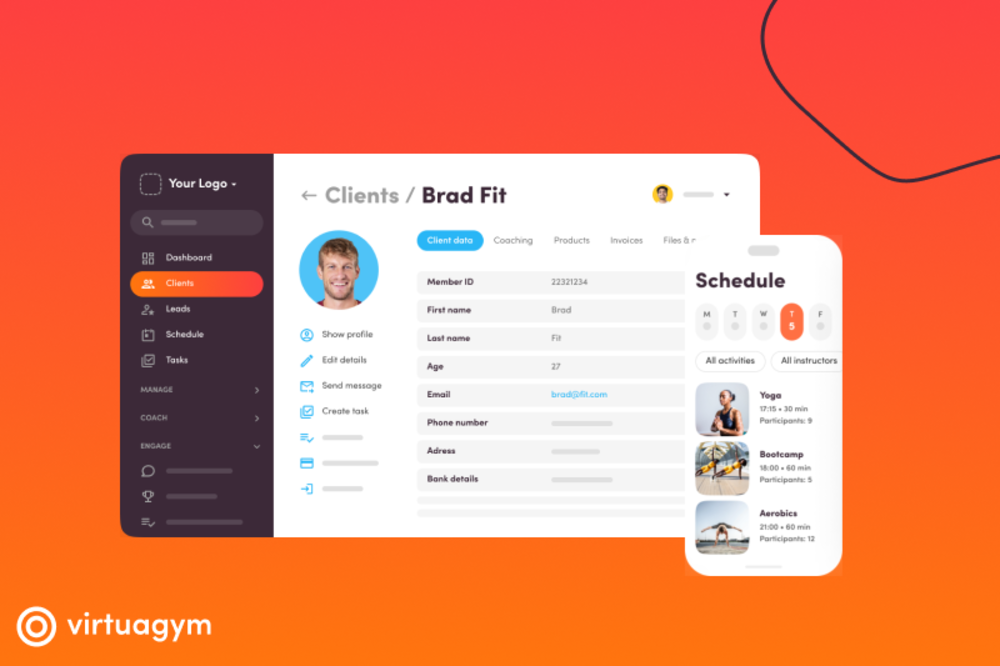
Software is a small line in your budget with a big job in the pre-opening months. Presales only turn into cash if people can sign up, agree to terms and be charged without you chasing them.
Set it up before the presale campaign starts. Check that your system covers:
- Online sign-up and digital contracts.
- Recurring billing, with follow-up on failed payments.
- Class and appointment booking.
- Check-in or access control.
- Reports that show active members against your break-even number.
Gold’s Gym Calgary made this a rule as it expanded across Alberta. The team picked its platform so each new location could open with booking, member management and communication already in place.
Virtuagym’s Membership Management handles sign-ups, contracts and recurring billing in one system. The members you presell become billing members on day one, without re-entering anyone by hand.
Conclusion
Before you sign anything, your plan should produce three numbers: total startup cost including reserve, monthly operating costs and break-even members. For the example gym, that’s $269,501, $25,792 and 397 members at $65.
If yours fall inside the benchmarks in this guide, you’re ready to commit money.
If they don’t, the gap is in one of the nine steps, and fixing it on paper costs far less than fixing it after opening day.
Once the doors open, the job shifts from finding members to keeping them. These gym membership retention ideas are the natural next read.
Set up billing, booking and memberships before your first presale. See how Virtuagym runs your gym from day one.
FAQ
How much does it cost to open a gym in 2026?
An independent gym costs $150,000 to $300,000 to open, a boutique studio $50,000 to $150,000 and a large commercial gym $300,000 to $500,000+. Franchises can pass $1,000,000. Hold three to six months of operating costs in reserve, which can push a lean plan to the top of its band.
What licenses and permits do I need to open a gym?
It depends on your city, county and state, so ask your local business licensing office and planning department first. Budget $1,000 to $5,000 for licenses and permits in total. The SBA’s licenses and permits guide links to each state’s portal.
What’s the first step in opening a gym?
Choose your gym type, because it sets your budget: from $15,000 for a personal training studio to $300,000 for an independent gym. Then build the break-even model: monthly costs divided by your membership price. Do both before you look at a single lease.
How do I choose the right location for a gym?
Compare spaces on rent plus buildout. US retail rent averages $24.79 per sq ft a year, plus 15–30% in NNN charges, and a former gym cuts fit-out costs. Confirm with your local planning office that the unit can operate as a gym before you sign.
What software do I need when opening a gym?
You need gym management software that handles online sign-up, contracts, recurring billing, booking and check-in. Expect $100 to $500 a month. Set it up before your presale campaign, so every founding member signs and pays through the system from day one.